I recently attended a concert featuring Mozart’s Requiem and Symphony Number 40. One of the most interesting things I noticed in this piece was the basset horn. As I was not familiar with the instrument I looked into the instrument and discovered that it plays a large role in the Requiem as well as the style of Mozart’s compositions.
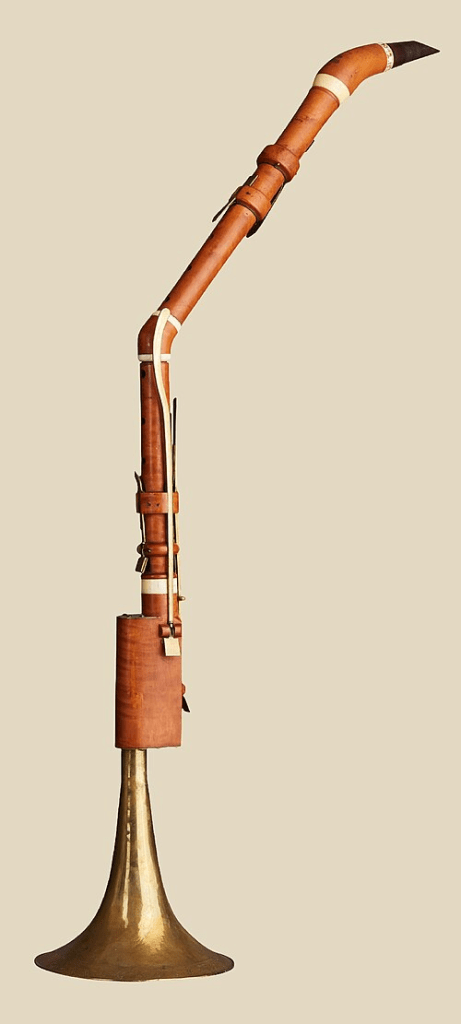
The basset horn is thought to have originated in Passau, a city in Lower Bavaria. The first basset horns (created around the 1760s) all are inscribed with “”ANT et MICH MAYRHOFER INVEN. & ELABOR. PASSAVII.” This is a Latin phrase meaning “Anton and Michael Mayrhofer invented and crafted [this] in Passau,” and these inscriptions provide the basis for our knowledge of the horns’ origins. The name of the basset horn comes from the word basset, meaning “small bass,” and its original curved, horn-like, shape. The instrument is a part of the wind family and has a single reed and cylindrical bore. The basset horn is typically transposed to an F, meaning that a written C sounds as an F and less commonly a G. The timbre of the basset horn is similar but darker than that of the alto clarinet, and earlier renditions of the instrument were more closely related to the basset clarinet. Basset horns can be divided into three categories: small, medium, and large bore basset horns. The most common modern variant is the medium-large, which plays with an alto clarinet mouthpiece and has a bore diameter of about 17.2 mm.
The use of this instrument was most notable in the classical period with composers such as Mozart including the basset horn in many compositions. This was partially due to Mozart’s proponent of the style Harmoniemusik, which encouraged the use of basset horns and other wind instruments. The basset horn was featured in Mozart works such as the Maurerische Trauermusik (Masonic Funeral Music), the Requiem, and Die Zauberflöte, reflecting its importance and unique capabilities. While this instrument is not widely known, its tone quality and beauty are reelected in numerous works and especially highlighted in those of Mozart.
 The Sound Effect
Leave a comment