The Philadelphia orchestra is one of the premier orchestras in the world, and with this distinction, comes the opportunity to use an organ to its fullest extent. With a history of performing major organ works such as the Saint-Saëns “Organ” Symphony, Casella’s Concerto romano, and Holst’s The Planets, the Philadelphia Orchestra continues to support a thriving organ program that features stars from across the globe.
The Orchestra was first based in the Academy of Music which held an Aeolian-Skinner Organ donated by Mary Louise Curtis. The organ had three manuals, 75 ranks, and 4,104 pipes, and was the largest organ in the world at the time of installation. Since the organ was built in 5 parts and designed for a sloping stage, the Academy of Music was a perfect venue for it due to its convex shape that allowed for the radiation of sound within the hall. It was installed in the Academy in 1960 and fit the location spectacularly as it could be moved on and off the stage. The Philadelphia Orchestra played in this venue from 1900 to 2001 when they moved into the newly built concert hall at the Kimmel Center.
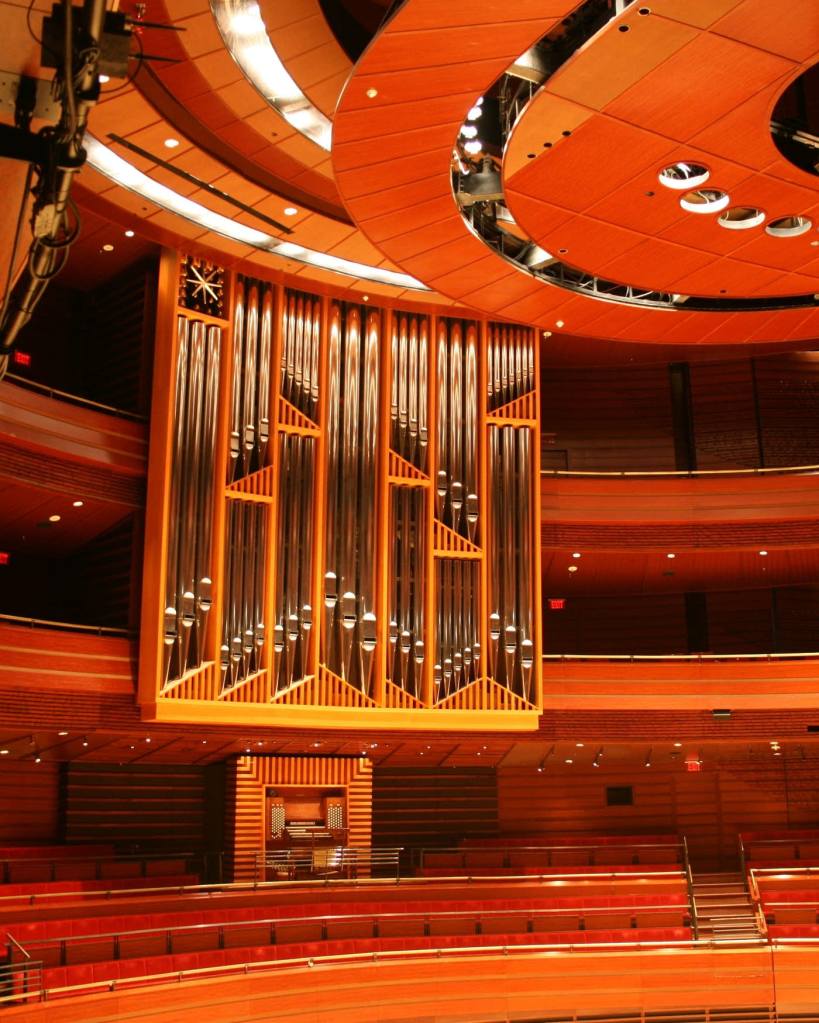
This concert hall, later given the eponyms “Verizon” and then “Marian Anderson” boasted its own set of impressive acoustics, and the organ was installed in two phases, the first of which took place in the fall of 2001. Phase two took place during the summers of 2004 and 2005. The organ was not completely installed until October 2005, when workers worked through the night so as not to disrupt the orchestra’s schedule. The organ features four keyboards and 6,938 pipes with the largest at 32 feet. The instrument is a tracker action by design, but it has a movable console which is connected to the instrument via a computerized electrical system. While the stopwork and scaling of the pipes was a collaboration between Dobson and Los Angeles organ builder Manuel J. Rosales, construction, voicing, and tonal finishing was Dobson’s responsibility. This organ has been played by many fantastic organists, including Paul Jacobs, Raphael Attila Vogl, Paolo Bordignon, and Alan Morrison.
While the orchestra has performed with the famed Wannamaker organ in the nearby Macy’s Department Store, these two were closely associated with the organization and were repeatedly featured in performances. Due to the close ties to the Curtis Institute of Music, Philadelphia is surrounded by great organists, and being well known and endowed, it also has great organs. While some orchestras may overlook the role of the instrument, the Philadelphia Orchestra takes full advantage of it and has consistently played some of the finest organ and orchestral music in the world.
 The Sound Effect
Leave a comment