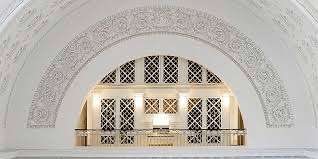
One of the most notable organs produced by Marcussen was the organ in the Christiansborg Palace Chapel located in Copenhagen, Denmark. This organ, situated across from the royal chapel, was built in 1829 by Marcussen & Reuter. The original organ consisted of 38 stops over 3 manuals and the pedal. However, the final array of the organ would leave space for a 39th stop. The organ reflects the modern tendencies of the time such as possessing freikombination assists on pneumatic instruments and further attempting to replicate the characteristics of pneumatic action. This organ was also not built with the practical mixture break that was common at the time. The build provided a breakthrough for Marcussen and paved the way for other prolific commissions such as Roskilde Cathedral and Our Lady’s Church in Copenhagen. From 1975 to 1980, the organ was rearranged by Poul-Gerhard Andersen, and following that, the transept was restored by Andersen’s organ building company. After a fire in 1992, the church needed to be restored. While the restoration was completed by 1997, the organ was not returned to its original position until 2009. Following the organ’s reinstatement, Marcussen conducted its restoration and conducted extensive research into the specifications of the old organand how best to imitate it. The current organ is entirely mechanical and possesses eight box bellows which can be operated by step or by electricity. The organ also has two couplers: II+III (Hauptwerk and Oberclavier) and II+I (Hauptwerk and Underclavier).
 The Sound Effect
Leave a comment