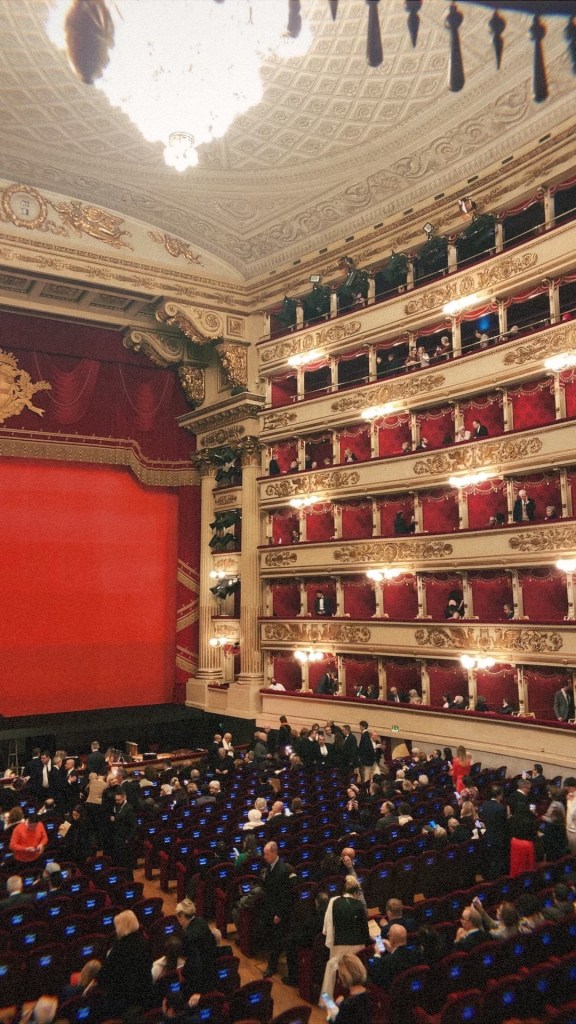
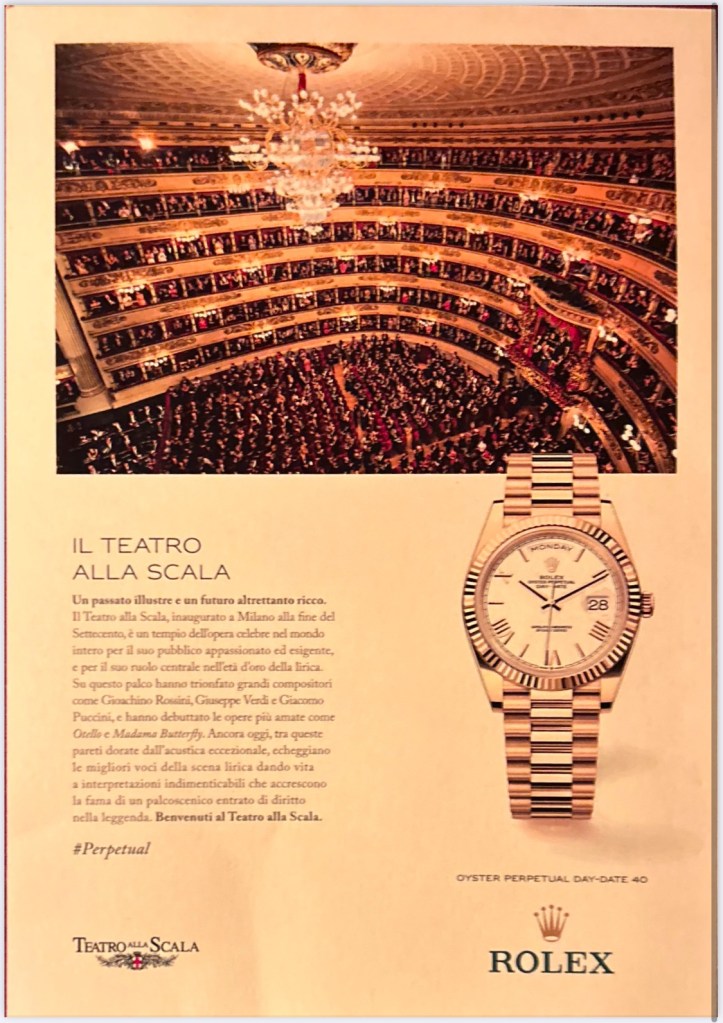
One of the greatest opera houses in the world, located in Milan, is La Scala. Known formally as the Teatro alla Scala, the institution was founded, in 1776, under Empress Maria Theresa of Austria, to replace the Royal Ducal Theatre, which had burned down earlier that year. The theatre opened on August 3rd, 1778, performing Antonio Salieri’s opera L’Europa riconosciuta. The building not only contains wondrous music but has also been lavishly decorated by the wealthy owners of boxes. Beginning in 1812, La Scala became the appointed place of Italian opera seria performing more than eight Rossini operas and beginning to expand its artistic programs to include ballet. In 1839, Oberto Conte di San Bonifacio commissioned a cycle of Verdi operas whose Nabucco cemented the approval of serious opera and forever linked the style with La Scala.
I was fortunate enough to be able to attend a performance of La forza del Destino, another opera written by Verdi with the libretto written by Francesco Maria Piave. This opera debuted in Saint Petersburg and after this debut, underwent revisions. Following these revisions, the opera was performed around the world in countries such as Rome and Spain, under the name “Don Alvaro”. Subsequently, Verdi made the final set of changes to the opera, making changes to the overture and writing a new ending in which Alvaro (one of the male leads) remains alive. This version of the opera debuted at La Scala on February 27th, 1869, and is the version still performed around the world today.
The performance I attended featured Elena Stikhina as Lady Leonora, Ludovic Tézier as Don Carlos of Vargas, and Luciano Ganci as Don Alvaro. The prestigious orchestra was conducted by Riccardo Chailly. The opera consists of a complex plot and lasts about three hours and 53 minutes with four acts. I found that while there were no standout arias, the production was amazingly well done with the theme from the overture returning again and again through the performance. I also found that the cast was superb and masterfully coordinated the large scenes with the entire contingent of soldiers in the war camp. An interesting detail that I noted was through the performance, the dress and scenery slowly became more modern, with the soldiers’ attire and weapons changing from historical to current. During the last scene of the performance, the spotlight was used masterfully to shine on the tree blooming to represent the rebirth of a dead Lady Leonora. The Teatro alla Scala lived up to my expectations and I recommend the experience to anyone who is able.

 The Sound Effect
Leave a comment